
Most of Most of us pass the same plants every day without knowing the rich stories or benefits they hold. On Sunday, June 28, guests joined us at Taza Park to change that; they slowed down, looked closer, and connected deeply with the land around them.
Each session was small by design, inviting attendees to learn from experts and leave with a deeper and more meaningful understanding of how various plants can impact your everyday life.
Herbal Connections marked the first in the Taza Event Series—a collection of unique experiences built around community, culture, and connection.
MEET THE VOICES BEHIND THE DAY
Teachings from the Land
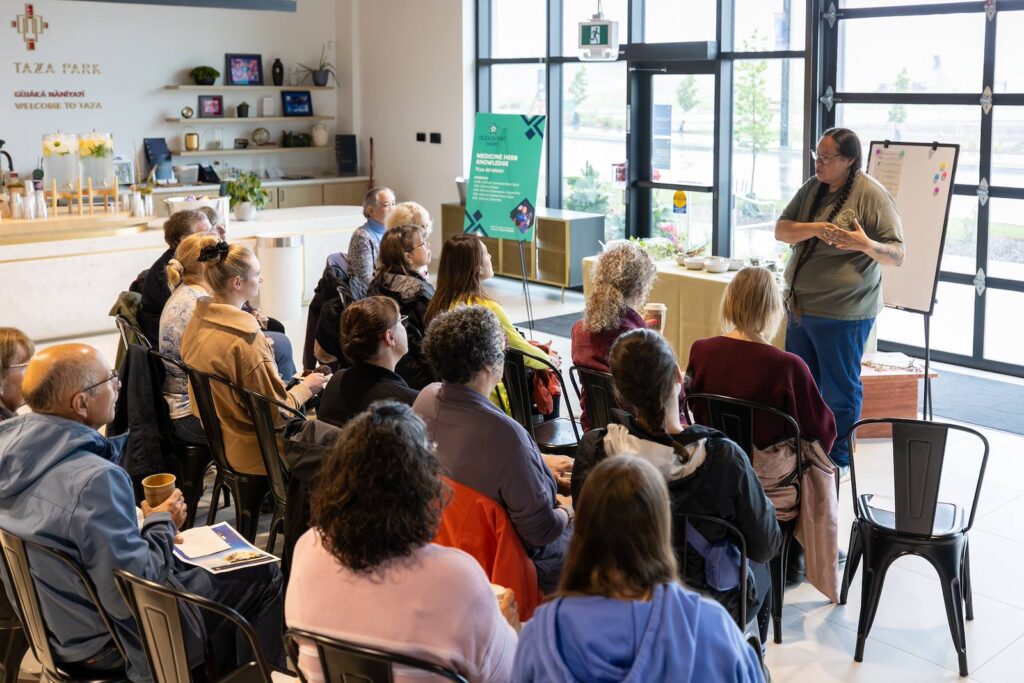
Each session was planned to feature one specific plant per hour, but guest curiosity quickly reshaped the schedule. Ellison adapted, briefly sharing about everything she’d brought during each hour instead of sticking to just one plant. It was one of those moments where the room’s energy shaped the experience.
One by one, Ellison introduced the locally harvested samples. She held each plant up, guided the room through the proper pronunciation of its name in the Tsuut’ina language, and passed it around for everyone to touch and smell for themselves as she explained its significance.
the plants Ellison brought to the table
Saskatoon Tree (K’ii chinà)
A plant with a vast range of unique uses. Its fresh berries can be eaten as-is, or the juice can be used to produce a deep purple-burgundy dye traditionally used on white horse tails, white-tailed deer, and porcupine quills. Dried, the berries become a staple ingredient in pemmican, a traditional Indigenous food of powdered dried meat and rendered fat. As Ellison shared her knowledge she passed along a meaningful practice: when you come across a large cluster of berries in the wild, take only two or three from each cluster, leaving the rest for other pickers and the animals who depend on them.
Poplar (Ch’áachi)
The ultimate survival plant. Every part of the plant has a purpose. The inner bark holds moisture and can serve as a short-term water source, fresh branches bend easily enough to build a shelter, the yellow dust from the trunk works as a natural sunblock and the fungus that grows on the tree can keep fire embers alive for extended periods. On top of it being a strong support for survival, Ellison shared an interesting detail that caught many people off guard: if you peel back the bark, the tree lets out a scent that smells remarkably like watermelon.
Sweetgrass (Tł’uwtłitsiní)
Recognized by its glossy, green blade-like leaves, most often seen bundled and braided together. It plays an important role in smudging, healing ceremonies, and prayer. Aside from ceremonial use, the leaves can also be boiled down into a tea, used as a cleanser for your body and hair, or woven together into intricate baskets.
Sweet Pine (Ganúzá tłitsiní)
Identifiable by its long slender needles and its versatility in benefits. As a plant very rich in Vitamin C, a spoonful of its needles can be boiled in water to create a tea or used to bathe in to cleanse the whole body. The sap pressed directly onto a wound acts as instant stitches, and in a survival situation the inner bark can also be chewed as a short-term water source. Fresh sweet pine buds can also be dipped in chocolate and enjoyed as a snack similar to chocolate-covered oranges.
Sage and Buffalo Grass (Tł’uwchidigoyí)
Both names are used interchangeably, referring to a plant with over fifteen known different types. Of the fifteen, Ellison brought three types to the afternoon. Women’s Sage is the most common but not the same as what you may find in a grocery store. Its stiff stem works as a natural hairbrush, the leaves brew into a soothing tea, and the seeds can be shaken loose while picking to encourage future growth. Men’s Sage carries similar benefits but produces no seeds. Horse Sage, named for its resemblance to a horse’s tail when hung to dry, is used for smudging and body cleansing, though its tea brews too strong to drink, its root can be fermented into a natural soap. Ellison tied them all together with one practical tip: boil any sage with sweet pine and you have a natural cleanser that works directly on body odour.
Wild Mint (Tł’àts’itsinà)
Provided one of the days’ most memorable stories. While a single cup of wild mint tea helps the body sweat out toxins during illness, a second cup acts as a powerful natural sedative, meaning you’ll want to be close to a place to lie down. Out in nature, you can identify it by breaking the stem; if it is square rather than round, you’ve found wild mint. Beyond the tea, crushed wild mint leaves serve as a natural pest repellent, and the boiled roots historically supported those managing diabetes as a short-term bridge until medication is available. Ellison also introduced wild horse mint (bergamot), traditionally used to treat flu and colds, ease cramps, and support postpartum recovery.
Tobacco (Ikàchinà)
Alongside these six plants, Ellison wove in tabacco carries a different kind of significance. In Tsuut’ina culture it is offered to the land as a way of asking permission before taking from it. Like picking plants, hunting, or harvesting. At Taza, we carry this protocol forward by burning tobacco at every groundbreaking ceremony, honoring the land before any project begins. Generally, it comes in cigarette, snuff, and loose forms. Beyond its important protocol use, the berries from the plant can be dried and used to make jewelry.
All the plants on the table Ellison shared were once exchanged between nations for hides, horses, and even hunting and fishing rights on other nations’ territories. They weren’t just medicine. They were currency, relationship, and connection across the land.
Where the Teachings BECAME SOMETHING, YOU COULD HOLD
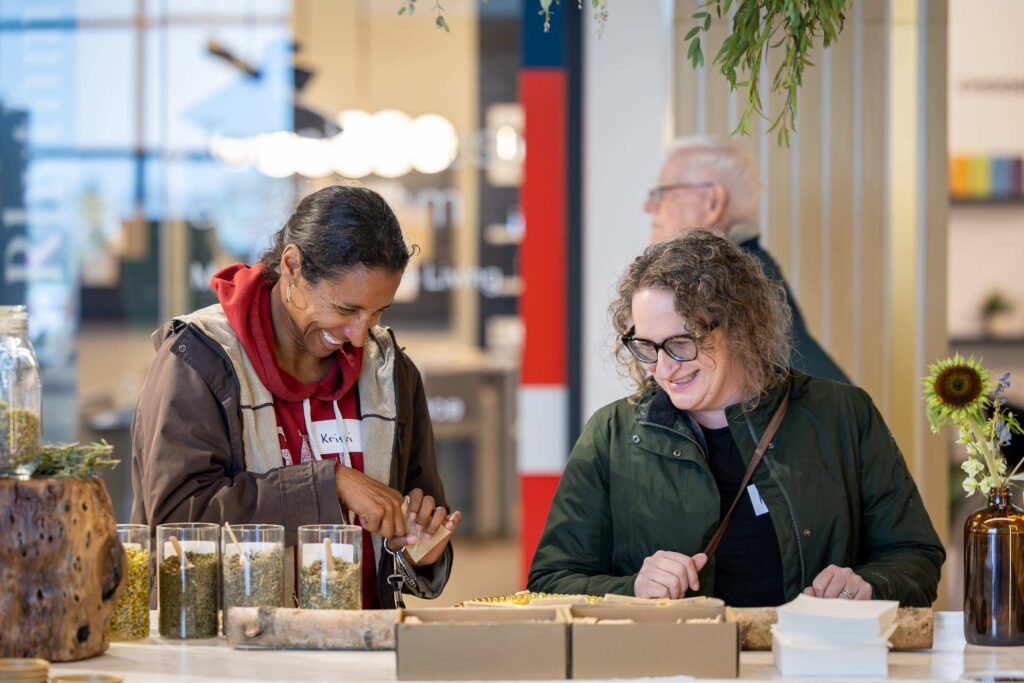
Following the teachings, Sachin led guests through the botanical spray making workshop, where the stories, warnings, and practical knowledge they had just learned became something they could hold.
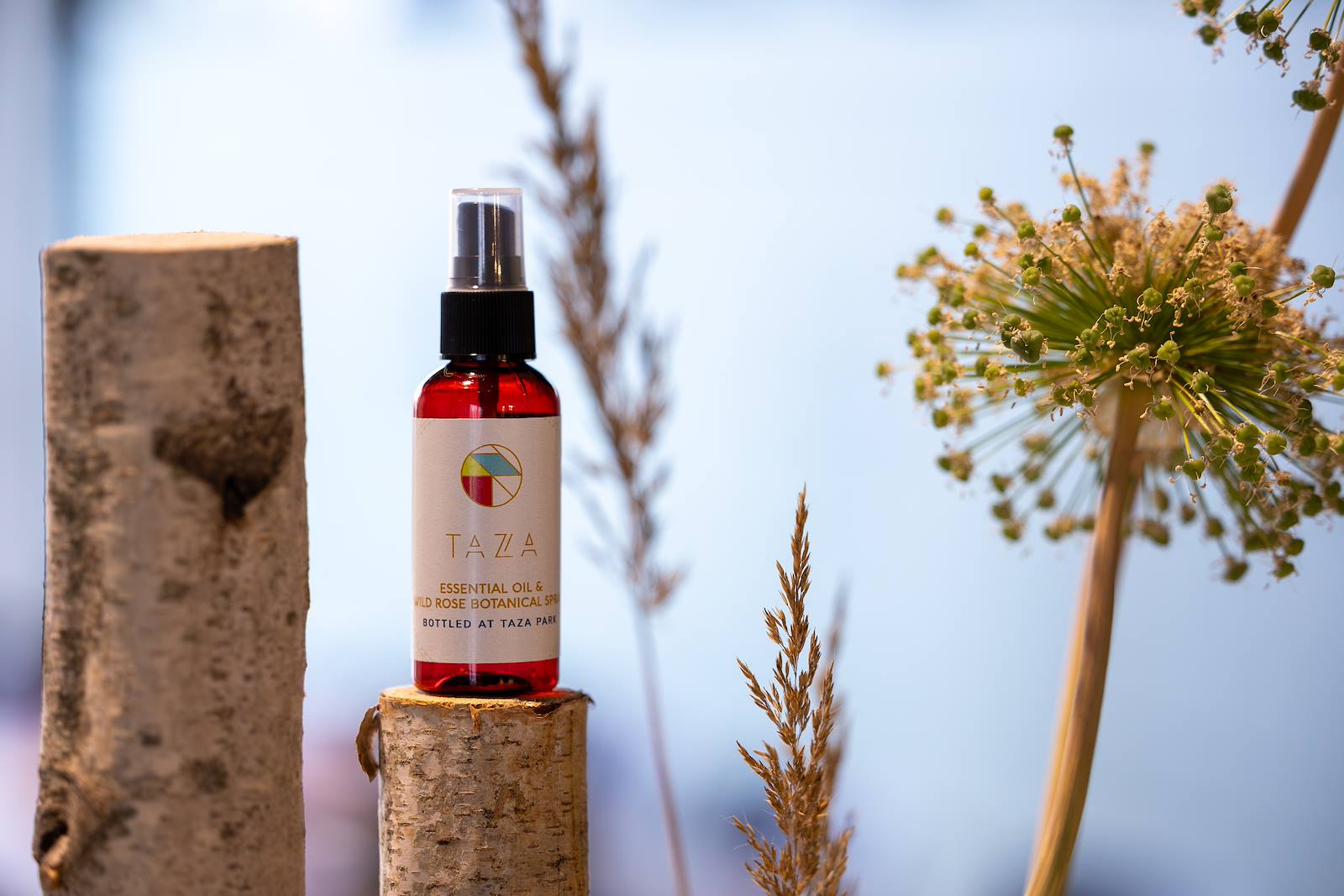
Sachin shared the skin benefits of each option, as guests chose from four botanical blends inspired by Ellison’s teachings: wild mint, sage, sweet grass, and sweet pine. After pouring their chosen blend, guests finished their spray with a base of either Alberta Wild Rose or Sweet Grass hydrosol.

The skin benefits behind each blend
- Sweet Pine, rich in natural aromatic oils and offers cleansing and antioxidant properties helping to refresh and tone the skin.
- Sage is naturally astringent, helping tone oily skin while also cleansing and refreshing the skin, its antioxidants help protect against stress.
- Wild Mint helps to soothe tired and overheated skin by offering an immediate cooling sensation as its menthol activates cold-sensitive receptors in the skin.
- Sweetgrass, traditionally associated with calming and comforting the senses, gently soothes the skin while its sweet, uplifting aroma supports relaxation and emotional well-being.
Tea, bannock and good company
Between the teachings and the workshop, attendees settled in at the tea bar featuring a variety of loose-leaf tea, sweeten with Tribal Honey by Dan Crane, harvested on Tsuut’ina land as well as, fresh Bannock bread, homemade Saskatoon berry jam and seasonal fruit from Little Chief Catering. It was an unhurried corner to share stories and connect with fellow attendees.
Stay In the LOOP
Herbal Connections was the first of many gatherings in the Taza Event Series. If you missed this event, subscribe to our newsletter to be the first to hear about upcoming experiences just like this one.