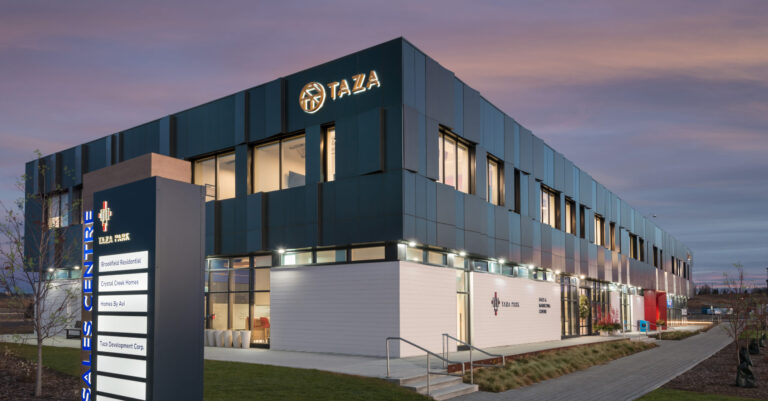

From a landmark road agreement to the first families through the door, here is how a teaching about future generations became a community you can drive to, shop in, and call home.
SUMMARY
- Follow Taza’s pivotal moments to date, from the 2013 ring road agreement to the first families receiving their keys in 2026
- Understand how culture is built into every beam and blueprint throughout the villages
- Discover what makes Taza a historically significant community development
If you have spent any time at a Taza event, there is a good chance you have already heard the word Wúsa. Tsuut’ina leaders reach for it in welcomes and opening remarks, usually before anyone says a word about development.
Wúsa translates to “the future,” and in Tsuut’ina governance it works as a test every decision has to pass: anything done today must benefit those born and those yet to be born. Taza is what that teaching looks like in practice.
For more than fifty years, Tsuut’ina leaders held a vision for the Nation’s eastern edge, waited out the conditions that were not yet ready, and then built: a road, a retail village, a water reservoir shaped like a beaver dam, and now a community village with families living in it. This is how Taza arrived, and where the story goes next.
Before the Shovels: A Vision Waiting for Its Moment
Taza’s story begins decades before the first shovel hit the ground. By the 1970s, Tsuut’ina leaders were already testing what the Nation’s land could do for its people, developing an 18-hole championship golf course and a residential community at Redwood Meadows.
The Nation had been pursuing economic development at this scale since the 1950s. The lesson carried east, to the stretch of land bordering a fast-growing Calgary, where the promise was greatest and the patience required was longest.
Much of that eastern land was still Harvey Barracks, a military base where Canadian forces had trained since the early 1900s. Those decades of live-fire exercises had left unexploded ordnance across the site, and when Canada agreed to return the land in 1991, a signature alone could not make the ground safe.
The cleanup would take the better part of a decade and more than $70 million. The Nation had a direct hand in that work through Wolf’s Flat Ordnance Disposal Corp., the company it founded to clear its own land.
A ring road that could connect the Nation to the city had been talked about since the 1950s, and even an agreement in principle, signed in 2001, took another twelve years to finish. Wúsa asks for decisions that serve the generation after this one. Tsuut’ina leaders spent those years making sure the conditions would be worth inheriting.
By 2013, those conditions were finally catching up to the vision. What follows matters to Nation members who watched it take shape from the inside, to the families now unpacking boxes in Taza Park, to the businesses choosing Buffalo Run for their next location, and to Calgarians who drive Tsuut’ina Trail without always knowing whose land carries them.
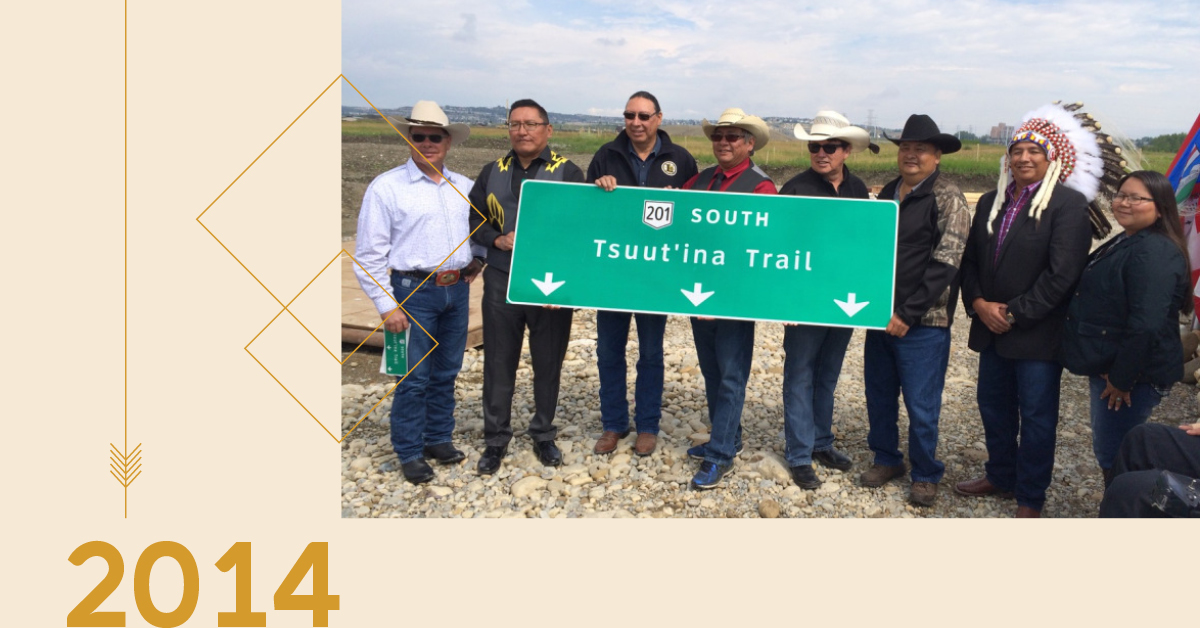
The Road That Opened the Door: 2013 to 2015
Like a lot of long journeys, this one began with a road. On 24 October 2013, 69 per cent of Tsuut’ina voters, 644 of 933, approved the Southwest Calgary Ring Road agreement.
The Nation transferred 1,058 acres to the Government of Alberta for the new corridor. In return it was guaranteed 5,338.1 acres of Crown land west of the existing reserve, valued at $44,420,683.50, of which 5,018.1 acres came as compensation and a further 320 acres the Nation purchased outright. The agreement also carried $275 million in cash, and $65,643,900 to relocate and rebuild the homes, businesses, and roads standing in the road’s path.
The agreement was a turning point for Tsuut’ina, and one leadership moved on quickly. In June 2014, 80 per cent of citizens voted to dedicate 1,200 acres along the Nation’s eastern edge, just west of southwest Calgary, for economic development.
After a competitive search, the Nation selected Canadian developer Canderel as its long-term partner in June 2015, structured as a true 50-50 partnership in which decisions are reached by consensus rather than majority.
Planning began the way Wúsa would ask it to, by listening first. That September the team travelled to Talking Stick Resort in Arizona to study what other Nations had built, and the master plan that followed took shape through an envisioning and ideas charrette with Tsuut’ina and Calgary leaders. In November, 38 Tsuut’ina citizens shaped the naming, branding, and vision of a place most of them would not see finished for decades.
A Name, a Plan, and a Promise Kept: 2016 to 2018
With a partner in place, the pieces began to form a picture. In April 2016, Canderel presented the master plan to Chief Roy Whitney and Council, and that July the Nation publicly unveiled its plans and its intention to build three distinct villages. Construction started shortly after on Buffalo Run Boulevard.
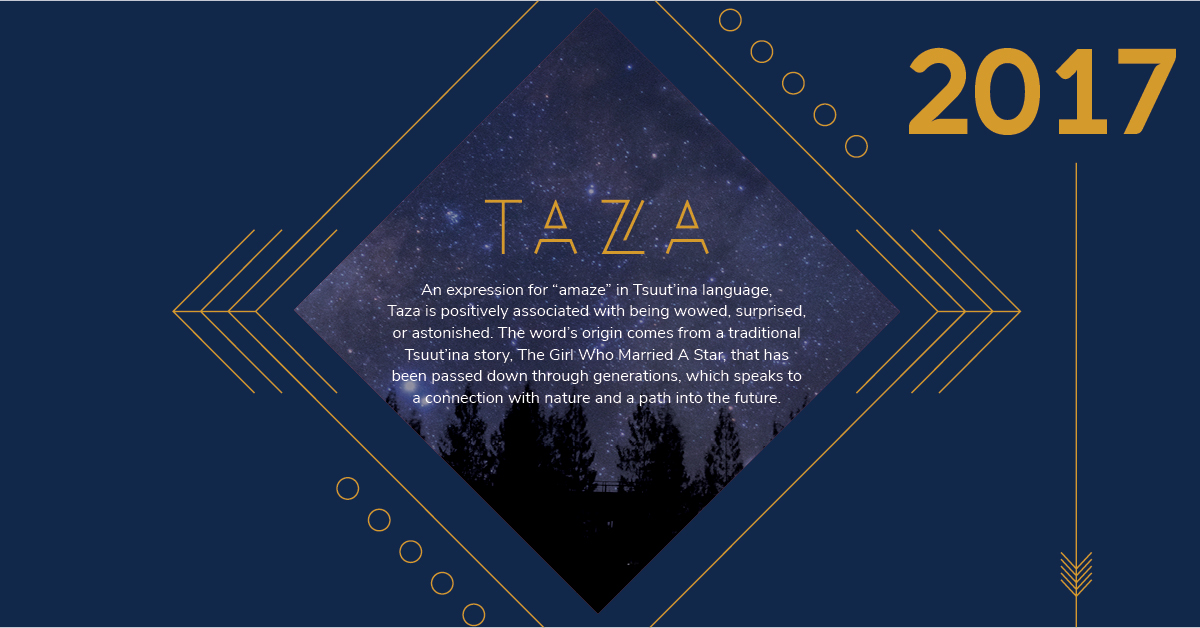
The development found its name in 2017. Drawn from the Dené story of the Girl Who Married a Star and gifted by Tsuut’ina Elder Bruce Starlight, Taza is an expression of wonder and anticipation, the feeling that something wondrous is coming. That July, the ring road through the Nation was officially named Tsuut’ina Trail, and in October 2017 Taza was introduced to the industry at the Calgary Real Estate Forum. The Tsuut’ina Development Authority was created the same month with five employees, four of them Tsuut’ina citizens.
Through 2018, Taza measured momentum in relationships more than in metres of road. Chief Lee Crowchild hosted a dinner series that brought Calgary’s business, arts, and community leaders onto the Nation to meet Tsuut’ina Elders and hear the vision directly.
In June, an open house barbecue in neighbouring Lakeview drew more than 650 people to share food and ask hard questions. Both were the partnership working as intended, with the Nation setting the terms and Taza carrying them outward.
The paperwork kept pace. That September the Nation finalized the Taza Park Head Lease, the master agreement with the Crown that cleared the way for subleases with retailers and tenants, and in October shovels went into the ground on The Shops at Buffalo Run, a 257,000-square-foot retail centre.

Where Culture Shaped the Concrete: 2019 to 2023
This is where the vision became something you could stand inside. Costco closed on an 18.6-acre site in October 2019 as Taza’s first tenant and opened in August 2020 to record crowds, the first Costco in Canada on First Nation land, with more than 80 jobs on day one.
Two months later, Tsuut’ina Trail opened to traffic, roughly ten kilometres of a thirty-one kilometre southwest leg that had been half a century in the making.
Meanwhile, in the village that would become Taza Park, the Taza Water Reservoir and Pumphouse was taking shape on paper. Taza consulted Elder and Knowledge Keeper Hal Eagletail, and his contribution shaped the design Zeidler Architecture delivered: a curvilinear enclosure that works as a security fence, carries solar panels, and alludes to both a beaver dam and a teepee, a nod to the Tsuut’ina as the Beaver People.
The design won a Canadian Architect Award of Excellence in December 2020, a full year before construction began, and Chandos Construction finished the $18 million build in 2023. A water reservoir built to be looked at, and not only used, is Wúsa in concrete.
The Shops at Buffalo Run kept filling. Tim Hortons, Dollarama, BMO, and a slate of local operators arrived through 2021, and the same year Taza launched the Bridging Connection program, pairing local artists with businesses across the villages.
That August, Taza broke ground on Taza Park, its first residential village, and then In April 2023, James Robertson was announced as President, arriving from the University of Calgary Properties Group, where he led the development of University District and the University Innovation Quarter.
The Year the Keys Turned: 2024 to 2026
The community came alive. In June 2024, The Shops at Buffalo Run celebrated its grand opening with a Blossom and Bloom event that drew inspiration from the crocus. By then, it had already already created an estimated 750 employment opportunities since 2022. September 2024 brought the first Canderel SuperHero Dash to Taza Park, and in October Taza earned a place on the Indigenomics Institute’s 10 to Watch list.
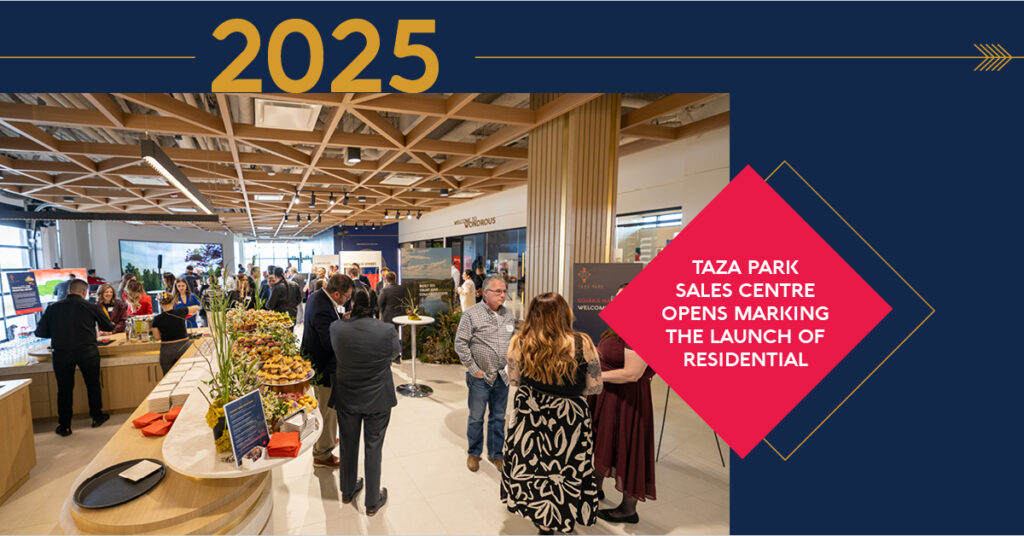
Residential development moved fast. In March 2025, Taza announced its first three builders: Brookfield Residential, Crystal Creek Homes, and Homes by Avi. In April, Taza confirmed a Real Canadian Superstore for Buffalo Run, and in May the Taza Park Sales & Marketing Centre opened to more than a thousand visitors.
That October, Taza announced Walmart Canada as the first anchor tenant for Taza Park West. Something Wondrous, Southern Alberta’s Indigenous music festival, welcomed its first crowds to Taza Park the same year.
In June 2026, Taza announced the first McDonald’s restaurant in Alberta to take shape under the cultural guidance of a First Nation.
The Tsuut’ina-Taza Cultural Advisory Working Group provided insight and guidance on the restaurant’s murals and Tsuut’ina-language signage. The group is a body of Tsuut’ina Nation members that carries Tsuut’ina language, traditions, and protocols through every phase of development, from design and construction to operations.
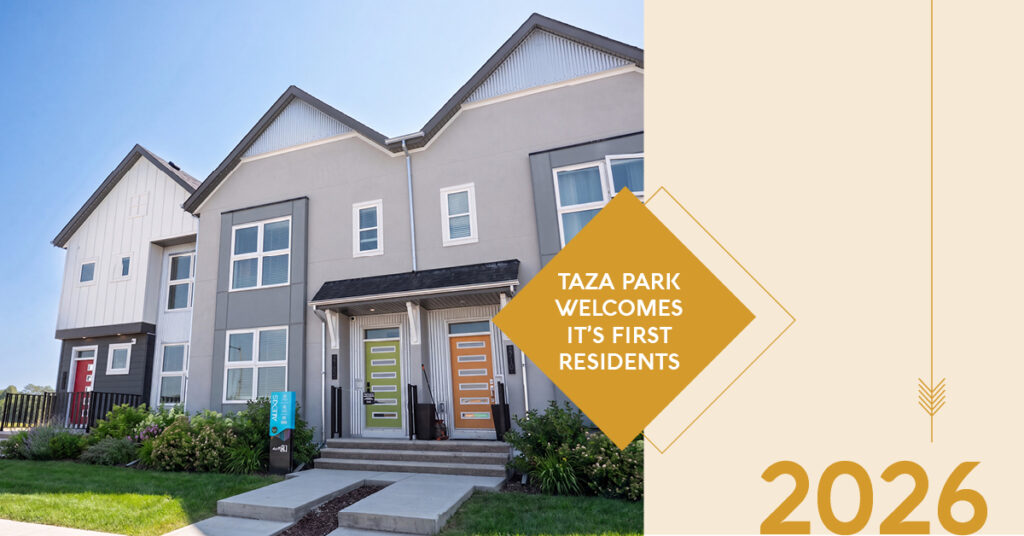
Then came the moment years in the making. Twelve years after the ring road vote, the first residents received their keys and moved into Taza Park in March 2026. Plans, infrastructure, and half a century of patience finally became a neighbourhood.

Be Part of What Comes Next
The first decade built the foundation. All three builders have welcomed residents and continue to sell homes, and construction carries from phase to phase.
Ahead lie parks, gathering places, pathways, bike lanes, and wetlands, alongside a Retail Main Street still to come, as Taza Park works toward its full vision of more than 6,500 residences and over 50 acres of green space across 470 acres.
Across the wider 1,200 acres, Alberta’s own major projects inventory now carries Taza at $4.5 billion and 17 million square feet of planned real estate, which is one way of measuring a promise kept.
Through all of it, the guiding idea has not changed. As President James Robertson puts it, Taza is “a generational commitment to building on Tsuut’ina land.”
What began with a road has become a place where culture, opportunity, and community grow side by side, and the teaching that started it, that today belongs to those yet to be born, is still doing the work.
Explore the master plan and the vision behind it, and sign up to follow every new milestone as it happens.